Sunday, October 26, 2014

Ghostman (Roger Hobbs)

Wow, by the review snippets on this book's jacket, I was expecting something spectacular and never-before-seen in the crime novel genre.  Instead, Roger Hobbs's Ghostman is filled with unmemorable characters and a plot that just didn't keep my interest.

The novel begins with an attempted Atlantic City casino robbery that goes awry quickly.  Only one of the two robbers has survived, and he ends up vanishing with all the money.  Marcus, the heist's "brains", is far away from the action and calls in the Ghostman to find out what happened; in so doing, the Ghostman can pay a long-owed "debt" to Marcus.  As his name suggests, the Ghostman's identity is always changing with the crime, and he makes himself invisible in between each one.  Simultaneously, Hobbs also flashes back to the foreign bank heist that got the Ghostman into Marcus's bad graces to begin with.

Though mildly entertaining at times, Ghostman was definitely not for me.  I found the characters very cookie cutter and the ending silly.  I seem to be in the minority however, so use your own judgment here.

MY RATING - 2

Sunday, October 19, 2014

The Tucci Table (Stanley Tucci)

Stanley Tucci -- not the most popular actor in the world, but you've definitely seen him in lots of places.  He stole every scene he was in in The Devil Wears Prada (with Meryl Streep no less) and was Streep's equal partner in Julie & Julia.  Now he has brought his Italian heritage to all of us with The Tucci Table, a cookbook that will certainly get well used in my kitchen.

The Tucci Table is filled with delicious recipes, colorful pictures, and timeless family stories.  He combines wonderful Italian dishes from his heritage with British recipes from his wife, all guaranteed to bring the family around the table. From Tuscan Tomato Soup to Fish and Chips to Beef Wellington to Raspberry Ripple Lemon Cake, there is something for everyone's palate in The Tucci Table.

In this rush-rush world where getting everyone together for dinner is often a fantasy, it's so nice that Stanley Tucci is still trying to make it a reality.

MY RATING - 4

Wednesday, October 8, 2014

The Secret Place (Tana French)

Tana French's Dublin Murder Squad series beautifully balances poetic prose, exciting mystery and engaging, wonderfully flawed characters.

The latter is French's true bread and butter, and it shines in The Secret Place through both the detective duo and the girls of St. Kilda's boarding school, where a murder has taken place.

Here's the thing: almost from the start I cared far more about the relationships between the teenage girls (two rival cliques handled in the most uncliched of ways) and the two detectives investigating the case than I did about the murder of a boy from the corresponding male boarding school.

And that's okay. French ensnares her readers not with sensational deaths or manipulative run-of-the-mill murder mystery tricks; she uses our humanity so that we have no choice but to find ourselves in the most unlikely of characters: the newbie murder detective, the daydreamy teenage girl, the high-strung headmistress.

Fans of French's former four novels will adore The Secret Place - especially in the last quarter of the novel, when Frank Mackey makes his cameo appearance and (as he always does) steals an already fabulous show.

RATING - 4.5


Sunday, September 21, 2014

Dear Daughter (Elizabeth Little)

I was excited to devour Elizabeth Little's Dear Daughter, as before-publication reviews were calling it the next Gone Girl. Um...not quite. There are a multitude of reasons why I just didn't care for this book, but I'm only going to mention a few of them.

Dear Daughter is narrated by Janie Jenkins, a woman convicted of murdering her mother but released from prison on a technicality.  Since Janie was considered a socialite and an IT girl, the trial transfixed the country.  Janie is determined to find her mother's "real" killer, and in so doing, finds herself in a small town in the middle of nowhere.  The American media is just as determined to keep tabs on her since they are convinced she got away with murder.

A.) I pretty much hated every character in this book.  None are likable, and it is extremely hard to feel any sympathy for any of them.  From Janie herself to her horrible mother to Leo the cop, I would not give any one of them the time of day in real life.

B.) Since Dear Daughter is narrated by Janie, the reader is forced to see the unfolding mystery through her eyes. Therefore, we are treated to such doozies as Janie getting shot in the shoulder and saying that red is just not her color. What???? What about screaming? Crying? Passing out? Which is what 99.9% of people would do if they were shot in the shoulder.

C.) The mystery is just plain boring, and the ending (when we finally find out who the killer really is) borders on a Scooby Doo revelation.

So Gone Girl this is not, but I'm going to give it a 2. Read it if it's the only book in the house.

MY RATING - 2

Saturday, September 13, 2014

Barefoot in Babylon (Bob Spitz)

Incredibly engrossing, Bob Spitz's Barefoot in Babylon tells the often harrowing behind-the-scenes story of the creation of the Woodstock music festival.  People usually think of Woodstock as the epitome of peace, where a bunch of hippies sat for a few days in a big field listening to music icons like Jimi Hendrix and Janis Joplin.  Reading about the organizers' tough journey to put the festival on, along with what actually took place that August weekend, is absolutely riveting.

Spitz starts at the very beginning, when Woodstock was just an idea in Michael Lang's mind.  Once Lang convinced a core group to get in on the action and they found a place to have the festival, they all needed to start organizing the performers, layout, sanitation, concessions, security, and a million other details.  To top everything off, they were met with a huge amount of resistance from the neighbors of the original festival location, so much so that they had to pick up and leave.  When people say that dairy farmer Max Yasgur saved Woodstock, they couldn't be more correct.

Spitz had a multitude of reliable primary sources when writing Barefoot in Babylon, including access to the organizers themselves, along with their papers and memorabilia.  He also has an uncanny ability of making you seem like you're right there in the action, which for most of us, is the only way we would ever be able to experience Woodstock.

MY RATING - 5

We Were Liars (E. Lockhart)

Word of mouth is a huge way to get people to read your book.  Just take E. Lockhart's We Were Liars for instance.  At my local library, there were over a hundred holds, and even though it's classified as a young adult novel, my guess is that there are many adults engrossed in it.  I began reading it on a plane ride from Philly to Minneapolis, and by the time I landed, I was three quarters of the way through.

If you've heard about We Were Liars, you've probably also heard that you should lie about the ending.  It's difficult to say much about this book without giving anything away.  But in a nutshell, it's narrated by Cadence, the oldest grandchild in a family who owns their own island for goodness sake.  Each summer, the family returns to this island; however, Cadence's fifteenth summer there is a complete blur.  She doesn't remember most of it, except that she was found on the beach with a head injury.  How she got there is the gist of We Were Liars.

There is one clue throughout the novel that gave me the slightest inkling of how the book would end.  If it wasn't there, I would have been completely surprised.  It's still a jaw-dropper though, and I highly recommend this novel for both young adults and adults alike.

MY RATING - 4

Saturday, September 6, 2014

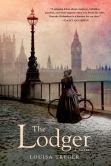
The Lodger (Louisa Treger)

Louisa Treger's The Lodger has an interesting story on how it came about.  Treger was looking for an angle about Virginia Woolf that hadn't been done before and came across something Woolf had written about peer Dorothy Richardson.  She decided to delve deeper into Richardson's life, of which nothing much had been written about up to that point.

A major English writer in the early twentieth century, Richardson did not have an easy time of it at first.  She was residing in a boarding house, trying to scrape up enough money to live on from her job, when she became infatuated with her friend's husband, Bertie (otherwise known as Mr. H.G. Wells).  Dorothy and Bertie began a passionate affair, but when Veronica, a new boarder, entered her life, Dorothy was torn between the two.  Because of the time she was living in, her reputation would be in tatters no matter which one she chose.  Treger weaves in plenty of history in The Lodger, with Dorothy beginning to write as the suffragette movement was taking place outside her walls.

This is a quick read, but I felt like the characters (though true) weren't fleshed out enough to hold my attention.  However, if you're interested in this time period and in peeking into a slice of literary history, The Lodger is worth a read.

MY RATING - 3